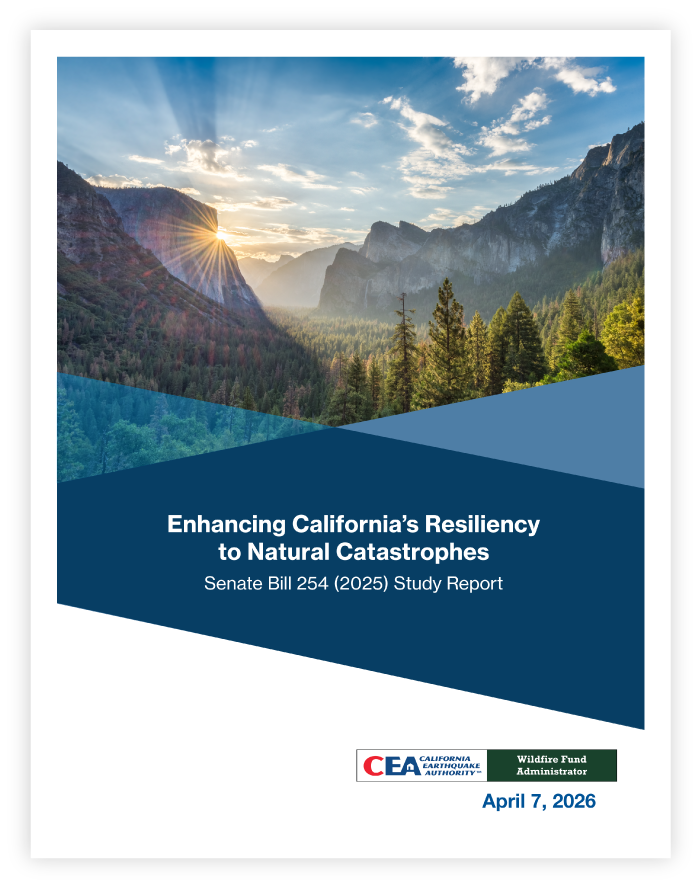
Senate Bill 254
The California Legislature passed and Governor Gavin Newsom signed SB254, which requires a comprehensive assessment to analyze and develop long-term reforms that protect access to insurance, reduce litigation costs, provide fair and expeditious compensation to claimants, support wildfire mitigation, safety, and community resilience, and ensure large electrical corporations are accountable for safety and also have the financial health to attract low-cost capital on behalf of ratepayers.
Governor Newsom’s Executive Order
California Governor Gavin Newsom issued his Executive Order (N-34-25) on September 30, 2025, to launch the next phase of his “whole-of-government response” to the economic and insurance consequences of the climate crisis and to direct robust governmental participation in the SB 254 Study.
The Governor’s press release regarding this Executive Order contains additional information regarding his administration’s collaborative support of the SB 254 study.
Research Study Documentation
Representatives of the five named agencies and departments listed below generously contributed their time and expertise as members of the study steering committee and as subject-matter-experts to the study process.
California Department of Forestry and Fire Protection (CAL FIRE)
Office of Emergency Services (Cal OES)
Office of Energy Infrastructure Safety (Energy Safety)
California Public Utilities Commission (CPUC)
Department of Insurance (CDI)
Click on the link below to access all written contributions submitted to the study.
The content, materials and ideas (“Submissions”) listed in these submissions have been provided by members of the public in response to CEA’s, in its role as Wildfire Fund Administration, call for submissions related to the SB 254 (2025) Natural Resiliency Study. Click the link below to access Stakeholder Contributions received as of 3/19/2026.
Additional background documents may be added at a later date.
Informational Webinars
- Informational Webinar #1 – Wednesday, December 10, 2025, 12 – 1 PM (PT)
- Theme: Study Origin, Approach & Opportunities to Engage
- Presentation (PDF)
- Watch the Webinar
- Informational Webinar #2 – Friday, February 6, 2026, 12 – 1 PM (PT)
- Theme: Key Themes Emerging from the Study
- Presentation (PDF)
-
Due to unexpected technical issues with the Zoom platform, the video file for this session could not be recovered despite extensive troubleshooting and recovery attempts.
We sincerely apologize for this inconvenience and understand the importance of access to these materials. While this recording is not available please reference the slide presentation to view the content shared during that webinar.
- Informational Webinar #3 – Friday, March 6, 2026, 12 – 1 PM (PT)
- Theme: Study Findings
- Presentation (PDF)
- Watch the Webinar
Submission of Stakeholder Contributions
The deadline we set for written submissions has now passed, but we encourage you to register as an interested party to receive study updates and notices about upcoming webinars and other potential opportunities for engagement and contributions.
Stakeholder Contributions Received
We appreciate the strong interest in the SB254 study and the submissions received. After being reviewed to ensure that they did not contain any overt political statements, commercial content, inflammatory tone, and other inappropriate material, as determined by CEA in its sole discretion, all submissions received and reviewed before the December 12, 2025, deadline have now been posted.
Please check this page regularly for updates and complete the form below to receive periodic email communications and announcements.
Please direct inquiries to SB254Questions@calquake.com.
The CEA complies with the Americans with Disabilities Act (ADA) by providing the annual reports posted on this website in appropriate alternative formats when requested. If you would like to request these reports in an alternative format, you may contact CEA's ADA Coordinator at (916) 661-5400, or by email to EEO@calquake.com.